


Water Softener
What Is Water Softener
A water softener is a whole-house water treatment system that removes hardness-causing calcium and magnesium minerals from your water through a process called ion exchange. A water softener addresses hard water, one of the most prevalent and devastating water problems. Hard water wreaks havoc on a home’s plumbing and appliances, clogging pipes and shortening the lifespan of dishwashers, coffee makers, and ice machines. The higher the temperature of the water, the more calcium and magnesium will solidify and harden into solid deposits inside your hot water heater. If you live in hard water territory, your water heater may sound like it is popping popcorn. This is because scale has attached itself to the heating element. As the temperature of the heater rises and the tank expands, the calcified rock deposits crusted on the heating elements start cracking and stretching.
Advantages of Water Softener
Effectively soften water
Water softeners are the only systems that can reliably and efficiently deliver soft water to your whole home. While salt-free water softeners can mitigate some effects of hard water, they do not actually soften water, leaving you with dry skin, streaky dishes, and brittle hair. Reverse osmosis systems can remove water-hardening minerals from water, but continuously running hard water through a reverse osmosis system can damage the membrane significantly, reducing the effective lifespan of the system.
Protect appliances
Water softeners prevent damage to appliances caused by limescale buildup. The effects on water heaters are particularly egregious, as heating elements coated in scale must work harder to heat water. As appliances are exposed to scale, their lifespans decrease, forcing you to replace them sooner than you would typically need to. A water softener is not just a water treatment system, it is an investment in your home’s health.
Enhance cleaning
Hard water prevents soap from lathering and leaves you with itchy skin and brittle hair. When water is treated by a softener, these effects are no longer an issue. Soft water allows you to use less soap and detergent when you clean your dishes, laundry, and yourself.
longer life
Water softeners can last as long as 20 years, but the average lifespan is 15 years. If the system is properly installed and maintained, you will only need to worry about restocking the salt supply for the system. When compared to the cost of prematurely replacing appliances because of damage caused by scale, the initial and upkeep costs of a water softener are a worthwhile investment.





Why Choose Us
Our factory
A comprehensive water treatment equipment company specializing in design, production, installation, and consulting services. Our production base is located on the beautiful banks of the fuchun river, adjacent to the hangzhou xinjing expressway, with convenient transportation. Purchase of standard steel structure new factory building with an area of nearly 3000 square meters in changxing national development zone, zhejiang province.
Production equipment
Crane, cutting machine, rolling machine, saw machine, lathe, automatic polishing machine, spray booth, rocker drill, automatic submerged arc welding, automatic argon arc welding machine, gas shielded welding machine, argon arc welding machine, plasma cutting.
Our product
Quartz sand filter, activated carbon filter, multi-media filter, iron and manganese removal filter, filter element filter, fiber bundle filter, bag filter, titanium rod filter, hair filter, water softener, ultraviolet sterilizer, ozone sterilizer, industrial pure quartz sand filter, activated carbon filter, multi-media filter, iron and manganese removal filter, filter element filter, fiber bundle filter, bag filter, titanium rod filter, hair filter, water softener, ultraviolet sterilizer, ozone sterilizer, industrial pure water equipment, reverse osmosis pure water equipment for drinking water, degassing tower, automatic dosing device, ozone mixing tower, ion exchanger, resin.
Production market
European and american markets, asia pacific market.
Types of Water Softeners
Salt-based water softeners
Salt-based water softeners are the most commonly used and effective softener types. Most water softener systems are salt-based systems, so there are a high number of salt-based options available. They come in a variety of sizes and are appropriate for just about every dwelling.
A salt-based water softener typically works by drawing heavy minerals in the water, like calcium and magnesium, into a resin within the softener and exchanging them for sodium (salt). By removing the heavy minerals, the water returns to a healthy neutral state.
The downside to these softeners is that the resin then needs to be recharged with salt. For most homes, this will need to be done about once a week. These water softeners are also much larger than salt-free or magnetic softeners, making them not the best choice for smaller spaces.
Dual-tank water softeners
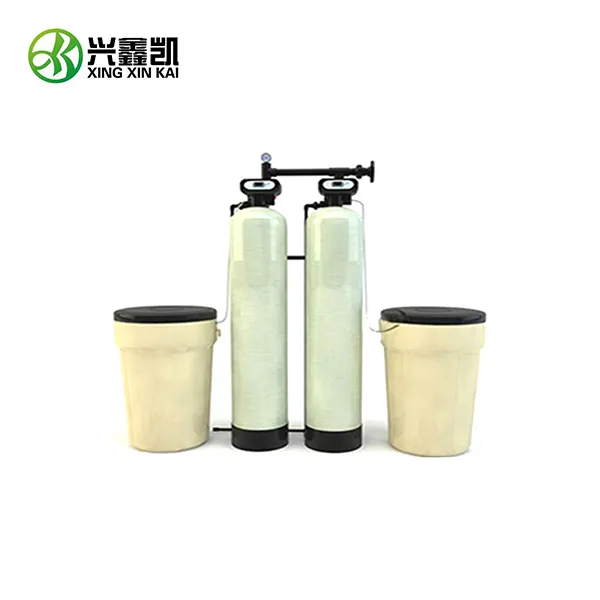
A dual-tank water softener is a salt-based softener with two resin tanks. This style is often the best water softener to use for well water due to its better ability to filter heavy minerals. These tanks function in the same way as a single-tank salt-based softener, except that when one tank is in the regeneration cycle, the other tank is still providing softened water to the household.
Dual-tank softeners aren’t necessary for most homes, and due to their size, they can be challenging to place and install. They also carry a higher price tag than the other styles and do need to be recharged. However, a dual-tank water softener can handle more water per regeneration cycle and never run out of softened water.
Salt-free water softeners
Understanding how the different types of salt-free water softeners work, as well as how much water they can treat on a daily basis, is integral to purchasing the right unit.
As indicated by their name, salt-free water softeners don’t use salt to remove heavy minerals from water; in fact, they don’t remove the heavy deposits at all. Instead, they condition the water so these particles cannot build up on faucets and showerheads. While the minerals remain in the water, they are put through a conditioning process.
Salt-free water softeners tend to cost more initially, do not use salt or electricity. These models are also smaller than salt-based systems, so they can easily be used for small- to large-size houses. However, these units may struggle with very high levels of hard water and households with higher than average water usage.
Industries Uses Water Softener
Food and beverage industry
Water softening is essential in the food and beverage processing industries to prevent scale buildup in boilers, steamers, and other equipment. It also enhances the flavour and appearance of products.
Hospitality
Water softeners are used in hotels, resorts, and restaurants to provide guests with softened water for bathing, laundry, and dishwashing. Softened water improves service quality while lowering maintenance costs.
Hospitals and healthcare facilities
Water softeners are required in healthcare facilities to prevent scale buildup in sterilisation equipment and to ensure that medical devices and instruments are cleaned and sanitised adequately.
Pharmaceutical industry
To meet strict purity standards, the pharmaceutical industry uses softened water for a variety of purposes, including ingredient preparation, equipment cleaning, and steam generation.
Manufacturing and industrial processes
To meet strict purity standards, the pharmaceutical industry uses softened water for a variety of purposes, including ingredient preparation, equipment cleaning, and steam generation.
Agriculture
Water softening can be used in agricultural settings to prevent irrigation system clogging and to increase the effectiveness of fertilisers and pesticides.
What Are the Parts of a Water Softener?
A water softener is made up of three components: a control valve, a mineral tank, and a brine tank. These three pieces work in conjunction to remove the minerals from hard water, monitor the flow of water, and periodically clean the system through a regeneration process.
The mineral tank
The mineral tank is the chamber where the hard water is softened. The water supply line feeds the hard water into the tank. The water seeps through the bed of resin beads, depositing the water-hardening calcium and magnesium ions. The water exits the tank soft and flows through your pipes to your household appliances.
The control valve
The control valve measures the amount of water passing through the mineral tank and into your house. The valve houses a meter that tracks the volume of water entering the mineral tank. As hard water flows through the mineral tank, the resin beads exchange their sodium ions for hardness ions. Over time, this depletes the capacity of the resin to effectively soften water. Before the beads become too burdened with mineral content to remove calcium and magnesium ions, the control valve automatically initiates a regeneration cycle. This maximum capacity is pre-programmed into the control valve’s onboard computer and is based on a range of factors, like the size of your house, the number of occupants, and the hardness of your water. Control valves are demand-initiated controllers, which allow water softening units to be extremely efficient.
The brine tank
The brine tank aids the water softening system in regeneration. It is a shorter tank that sits adjacent to the mineral tank. The brine tank holds a highly concentrated solution of salt to restore the resin beads’ positive charge. Salt is manually added to the brine tank in the form of pellets or blocks. These dissolve in the water at the bottom of the tank. When the control valve registers the softening capacity of the resin is diminishing, the heavy brine solution is drawn out of the tank and flushed through the resin in the mineral tank. If the brine tank runs out of salt, the water passing through the unit will no longer be softened.
A water softener works through basic chemistry. To understand how all the pieces fit together, it’s helpful to know the science of hard water.
Certain minerals — particularly calcium and magnesium — are responsible for making water hard. These “hardness minerals” can irritate your skin, dry out your hair, keep soap from lathering and even build up in your water heater, dishwasher and other water-using appliances or plumbing fixtures.
Calcium and magnesium are ions that have a positive charge. That means they can be attracted by a negative charge, much like opposing magnets. That’s why your water softener contains negatively charged resin beads. These beads attract the mineral ions and trap them, while the rest of your water flows through the system — and the result is soft water.
To keep working effectively, the resin beads need to be flushed or cleaned of the trapped positive ions in a process called regeneration. The system uses a separate tank containing a brine solution full of sodium ions to wash away the hardness minerals. Depending on what kind of water softener you have, regeneration may occur at fixed intervals based on how much time has passed or your water usage.
Prepare the area
Clear and sweep the installation site to remove dust and debris.
Align the water softener
Ensure that the system is positioned correctly with the inlet connected to the water supply and the outlet facing the water heater’s direction.
Shut off the water to your house at the main water line
The last thing you want is water spewing from the pipes during the installation process. To prevent this, shut off the water supply to your home and turn off the power and water supply to the water heater.
Drain the water lines
Open a couple of bottom-floor faucets or hose bibs to ensure all the water exits your house’s water supply.
Cut into the main water supply line with a pipe cutter
Use a pipe cutter to cut into the water-main leading into the supply line. Since you are installing a whole-house softening system, you need to connect the inlet and outlet lines directly to the main water line.


Measure, cut, and install the pipes
Measure and cut the pipes to fit and solder on any nipples and fittings before connecting the pipe to the bypass valve.
Clamp the drain hose to the softener, then feed it to where it will drain
Because the water softener needs to discard the brine solution after the regeneration cycle, you must clamp the drain hose securely and feed it into the dedicated drain. The end of the hose will need to have at least two inches above the drain hole to prevent back siphoning of the wastewater.
Connect the brine tank’s overflow tube
Overflow tubes also help to prevent the brine tank from flooding and overflowing. Refer to the manufacturer’s guide for instructions regarding height and placement.
Power on the system, turn the valve to the “bypass” setting and flush the water through the system to remove any sediment or debris
Open the valve very slowly to let in the water while releasing any air in the pipes. Follow the manufacturer’s instructions for setting up the flushing schedule and for adding salt to the tank.
Our factory
A comprehensive water treatment equipment company specializing in design, production, installation, and consulting services. Our production base is located on the beautiful banks of the Fuchun River, adjacent to the Hangzhou Xinjing Expressway, with convenient transportation. In Hangzhou, our sales department is located near the Shida freight market and has established long-term cooperative relationships with multiple freight companies, greatly facilitating the transportation of customers' goods. Production equipment: Crane, cutting machine, rolling machine, saw machine, lathe, automatic polishing machine, spray booth, rocker drill, automatic submerged arc welding, automatic argon arc welding machine, gas shielded welding machine, argon arc welding machine, plasma cutting.


certificate

FAQ